WiLine Edge Cloud - Engineering AI Infrastructure Around Measured Latency Reality
Enterprise AI infrastructure decisions should not be driven by assumptions. They should be driven by measured network behavior.
A large-scale latency study conducted across 8,456 global vantage points, measuring RTT to 6,341 edge servers and 69 cloud data center locations, provides empirical clarity on this topic.
The findings are unambiguous.
While 58% of end-users can reach a nearby edge server in less than 10 milliseconds, only 29% can achieve similar latency from the closest cloud region. At the 20 ms threshold, 82% of users are covered by edge infrastructure, compared to significantly lower coverage from individual cloud providers [document].
This is not a marginal difference. It is architectural.
Latency as an Infrastructure Constraint
Modern AI workloads multimodal inference, real-time video analytics, industrial automation, distributed agents are latency-sensitive by design.
When inference loops operate within tens of milliseconds, adding 40–100 ms of round-trip delay fundamentally changes application behavior.
The cited study demonstrates that edge servers provide lower latency than cloud locations for 92% to 97% of end-users globally [document]. In many cases, the latency difference falls within the 10–100 ms range.
For AI inference pipelines, that delta can determine whether processing is interactive or degraded.
For agentic AI systems coordinating across workflows, that delta becomes state propagation delay.
For VDI and AI-enhanced collaboration environments, that delta becomes user-perceived responsiveness.
Infrastructure topology becomes part of application logic.
Geographic Density and Latency Distribution
The same research reveals an important regional dynamic.
In regions where hyperscalers have dense regional presence such as Western Europe cloud latency can approach edge latency, with average differences near 10 ms [document]. However, outside those dense regions, coverage drops sharply.
Africa had zero measured cloud data centers in the dataset at the time of measurement, while edge servers provided significantly broader proximity coverage [document].
This regional asymmetry confirms a critical infrastructure principle:
- Cloud centralization benefits core markets.
- Edge distribution benefits everywhere else.
WiLine Edge Cloud is designed around metropolitan deployment strategy rather than continental centralization, aligning compute placement with real geographic usage patterns.
Power-Law Load Distribution and Capacity Engineering
Latency alone is insufficient. Capacity distribution matters.
The study identifies that edge proximity follows a power-law distribution. Of 6,341 observed edge servers, only 2,855 were closest to at least one end-user, and some edge nodes were closest to as many as 81 end-users, while 1,624 were closest to only a single user [document].
The measured power-law exponent (α = 2.78) indicates natural load concentration and hotspot formation.
For infrastructure architects, this has direct implications:
- Proximity-based assignment without intelligent orchestration can oversubscribe specific edge nodes.
- Capacity-aware scheduling is mandatory.
- Edge must be complemented by elastic core resources.
WiLine Edge Cloud is built with this principle in mind. Edge zones operate with high-availability clustering, live migration capabilities, and workload-aware orchestration. When local capacity thresholds are approached, workloads can be rebalanced across distributed zones or complemented by higher-capacity core environments.
This is not an edge in isolation. It is a coordinated edge-core topology.
Empirical Impact Under Workload Stress
The research further emulates workload intensity using traditional cloud cluster traces, modeling both low (<10,000 active requests) and high (>100,000 active requests) scenarios [document].
Under low workload conditions with cloud support, 59% of user requests achieved sub-10 ms latency. Under high workload intensity, that percentage dropped below 40% when edge resources were constrained [document].
The implication is not that the edge fails.
The implication is that:
- Edge must be provisioned intelligently.
- Hybrid augmentation is necessary under peak load.
- Resource orchestration determines real-world performance.
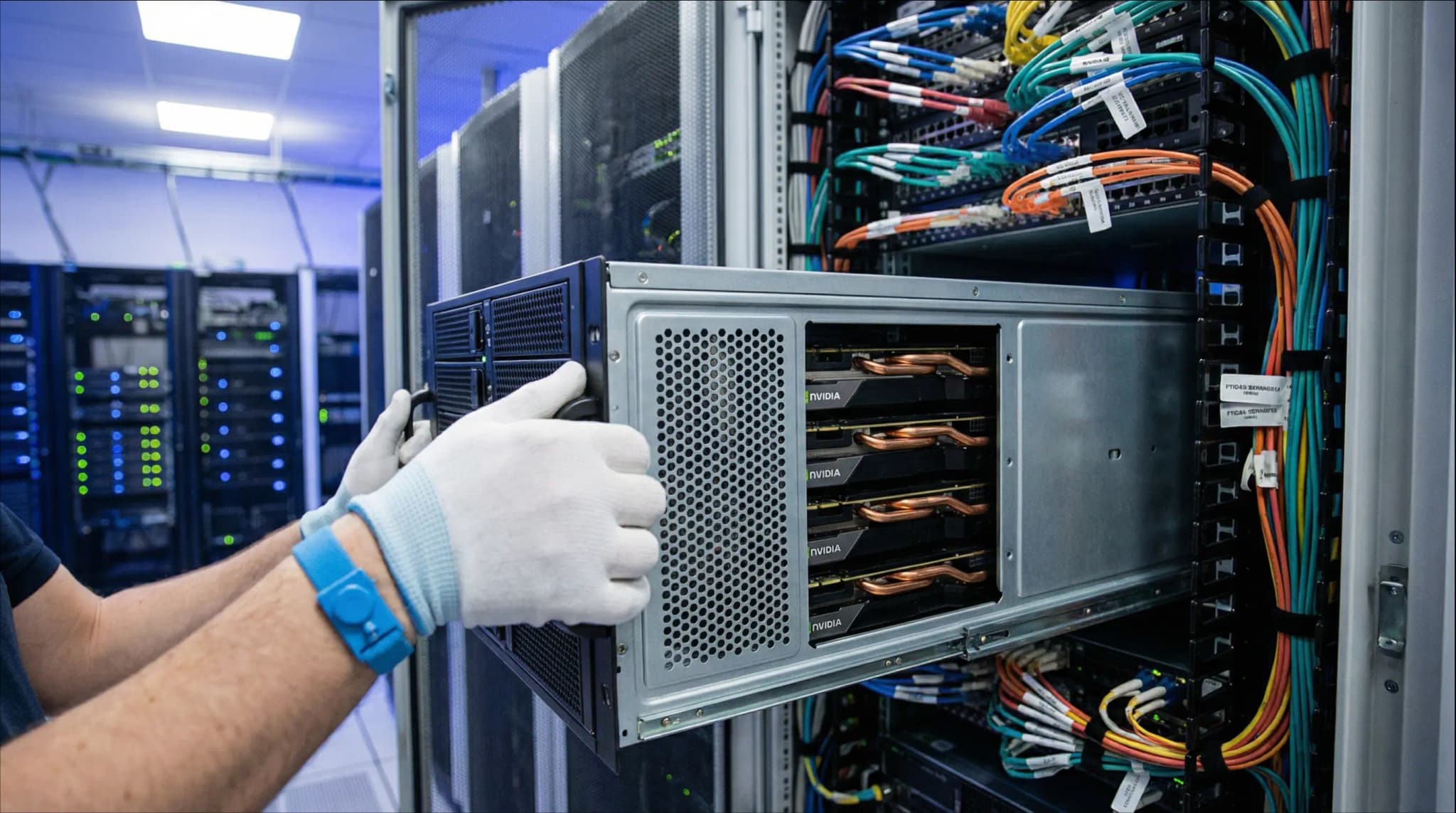
WiLine’s architecture reflects this operational reality. Bare metal GPU hosts, distributed storage, and network fabric are engineered and maintained as managed infrastructure. Customers do not manage node-level availability; high availability and live migration are integrated at the cluster level.
This allows AI workloads to execute within deterministic latency envelopes while maintaining resilience during load spikes.
Infrastructure Designed for AI Execution Patterns
The research concludes that edge servers are better suited for latency-critical applications for the significant majority of users [document].
AI is inherently latency-critical.
Multimodal inference pipelines, agent coordination, real-time analytics, and computer vision workloads operate within tight execution windows. Centralized regions introduce variable network delay and inter-AS path fluctuations, further amplifying latency unpredictability [document].
WiLine Edge Cloud was designed around three engineering principles aligned with these findings:
- Compute must be placed within metropolitan latency boundaries.
- Capacity distribution must prevent hotspot saturation.
- Hybrid coordination must preserve elasticity without sacrificing proximity.
The result is an architecture that acknowledges physical network realities instead of abstracting them away.
Conclusion
Measured global latency data confirms what AI infrastructure teams increasingly observe in production: proximity matters.
Edge infrastructure provides lower latency to the overwhelming majority of users. Regional centralization cannot substitute for distributed deployment. Capacity-aware orchestration is required to avoid localized congestion.
WiLine Edge Cloud is engineered around those empirical realities.
AI infrastructure should not be designed around where hyperscalers happen to have built regions.
It should be designed around where your users, devices, and data actually are.
WiLine is making that future possible by helping organizations:
- Move AI closer to data and users
- Deploy sovereign, compliant infrastructure
- Enable real-world agentic AI
- Build secure, resilient edge-to-cloud architectures
Watch the video to see how WiLine is redefining AI at the edge and helping enterprises build for what’s next: https://youtu.be/6tCNi2eqRtI
Head of Cloud - Danilo Murbach