The AI Risk We Need to Talk About Before It Becomes a Business Problem
As agents become part of everyday operations, relying on one provider-controlled model API is no longer a technical shortcut. It is a business dependency.
There is a conversation our industry needs to have, urgently.
The major LLM players are doing incredible work. From OpenAI, Anthropic, Google, and others we should be taking advantage of their capabilities, learning from their innovations, and building on top of their models.
As enterprises transition from experimenting with AI to deploying AI agents to fulfill customer requests, generate code, analyze documents, enable workflows, and make decisions, one sobering insight emerges: many are increasingly reliant on a single model provider's API for critical operational functions.
This is not just a technical proposition, but a business one.
If a preferred model becomes unavailable, deprecated, altered, capacity-constrained, or simply too expensive, what happens to the agentic process that depends on it? Is the process halted, slowed, manually entered, or do other controlled processes serve as a backup?
These are not theoretical edge cases. The US National Telecommunications and Information Administration warns that "foundation-model markets may tend to consolidate... An algorithmic monoculture... poses significant risks to the ecosystem." [1] Ookla's analysis of 3.72 million user-reported issues revealed that days with "high signal disruptions" across four platforms jumped from 6 in Q1 2025 to 51 in Q1 2026, but the report's more compelling lesson is that "reliability is a multi-faceted problem" including "APIs, routing, capacity, identity, connectors, cloud control planes, and network access." [2]
Meanwhile, model lifecycle management is another consideration: OpenAI and Anthropic have both published policies around model retirements, and it's reasonable to assume that applications built on top of these models must re-platform when a model is deprecated - Anthropic has explicitly stated that requests to a retired model will fail. [3] [4] .At the most basic level, commercial terms and conditions are rarely set in stone: OpenAI's Business Agreement, for example, states that "changes to the Pricing Page shall become effective 14 days after posted." [5]
None of this means that companies should avoid using frontier models. What it does mean is that prudent companies should avoid developing a production runtime around a single frontier model.
The future is not anti-frontier model, but it is intensely pro-control.
With that context, WiLine's AI Edge Cloud direction is best understood as a response to the exact dynamics described in this article.
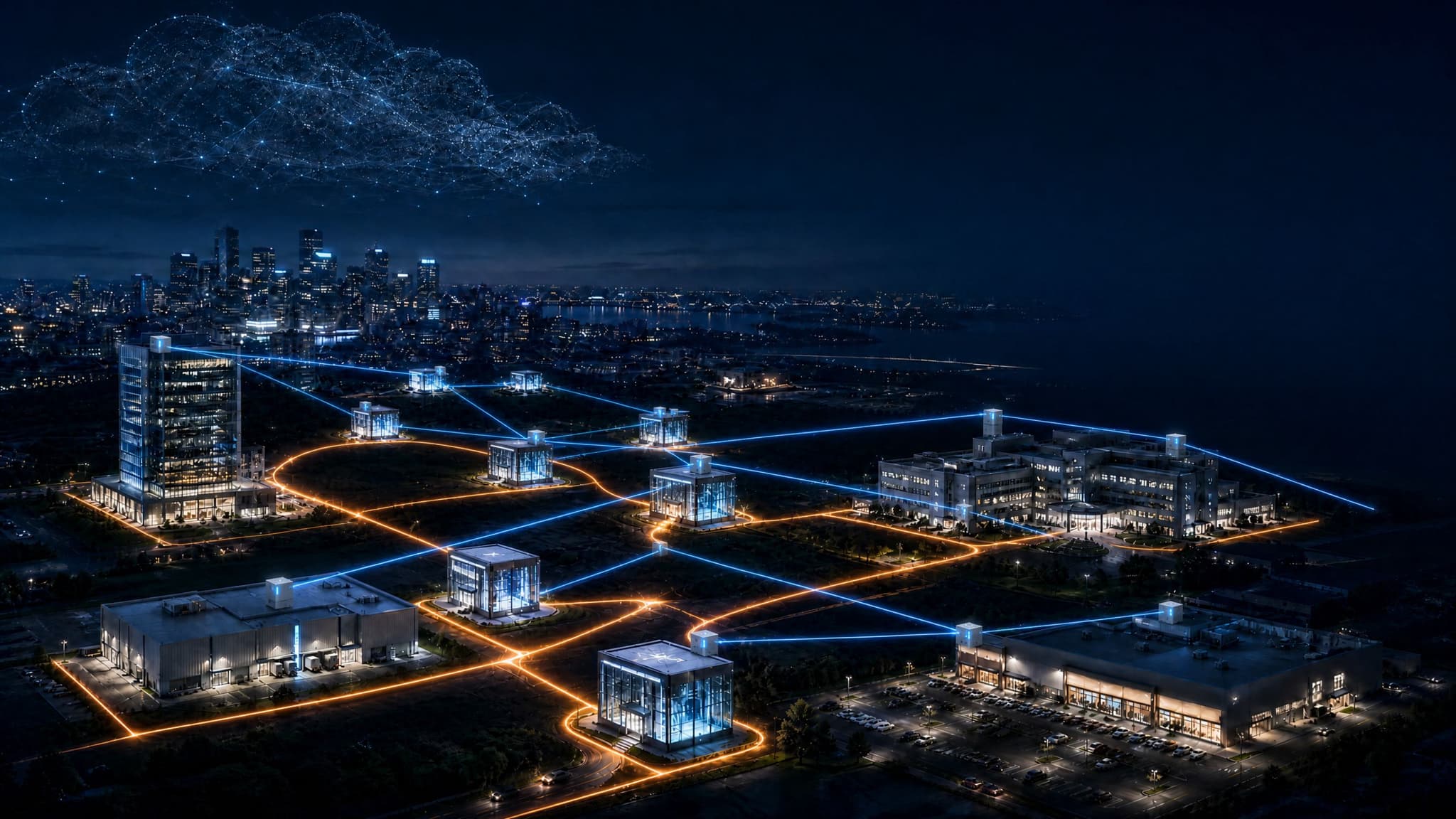
We didn't set out to build a model wrapper and work backwards: we focused on the distribution layer first. We provide dedicated internet, fiber, fixed wireless, SD-WAN, and managed Wi-Fi services over our fiber and rooftop access infrastructure. [6]. In addition, we've been building out the infrastructure stack to enable businesses to host AI workloads on-premise and closer to their data, users, devices, and operations: bare-metal GPUs and CPUs, storage, Kubernetes, VPC capabilities, implementing AI Edge Zones in 15 US regions. [7]
This is not an auxiliary capability in our portfolio, but rather one that is converging with our core strengths as part of a unified vision.
Because the next generation of enterprise AI isn't simply about pushing everything through to a common, centralized, black-box endpoint. It's about understanding which workloads benefit from a front-end model, which can be served by a controlled model, which data ought to stay close, and which decision loops need to occur on the device, in the network, or in proximity to valuable data.
As WiLine CEO John McGuire aptly puts it:
"You don't need a Lamborghini just to drive to the grocery store for a few items. You can walk, ride a bike, or take a practical city car instead."
This philosophy highlights a growing shift toward architectural efficiency: matching the right model size to the right job to optimize both performance and cost.
Enterprises may well continue to rely on frontier models for their most important reasoning tasks, while operating other workloads - including local processing, classification, redaction, computer vision, routing, or a lighter-weight agent mode - on more accessible, observable, and controllable infrastructure.
When a preferred model vendor has an issue, the business doesn't find itself scrambling to retrofit an entirely new process. Certain workloads always degrade gracefully, or run on parallel, simpler processes, or have been moved closer to data or decision points that can't be interrupted.
This is the idea of a controlled inference path.
It doesn't mean that every model produces identical results, but it does recognize that some processes need the frontier, some need proximity, some need data control, some need a cost certainty, and some simply need to continue operating.
We are uniquely positioned to help enterprises design around these principles, because we control the distribution layer while also providing infrastructure and security stack components that form a stack around model inference.
Our network and edge strategies and products don't exist separately, but rather converge on a common architecture.
And we are relentlessly focused on making that vision a reality: our engineering teams are expanding the AI Edge Cloud on a daily basis, enabling enterprises to bring even more workloads close to where they need to run in order to realize the full potential of generative AI. This is what it means to think about the future realistically, but also to be energized by it.
We believe that over time, these sorts of controlled processes will become table stakes for any serious enterprise AI investment. Not because frontier model providers will vanish, but because no prudent business will rely on any one provider for its most critical AI processes without having an alternative, local, controlled option for when things change.
The right time to start thinking about those options is before an outage, retirement, capacity constraint, or sudden price increase renders their absence brutally obvious.
At WiLine, we're building the network and AI Edge Cloud infrastructure for that moment today.
Start with one critical workflow: understand what processes are occurring behind every model, API, connection, and data store. Ask what needs to be always-on, what can tolerate performance degradation, and what needs to be closer to where it's needed. This is how strategic AI infrastructure design begins.
References
[2] Ookla, “AI Platform Reliability: Downdetector Data from Millions of User Reports”.
[4] Anthropic, “Model Deprecations”.
[5] OpenAI, “Services Agreement”.
[6] WiLine, Homepage.
[7] WiLine, “AI IaaS — Bare-metal GPU, CPU, Storage & Edge Zones”.
Written by

WiLine Marketing Manager
Senad lives at the intersection of technology and communication - where the best marketing actually happens. With years of experience in brand strategy and performance marketing, he specializes in turning complex, fast-moving tech into sharp narratives that build authority, drive demand, and leave a lasting market impression.