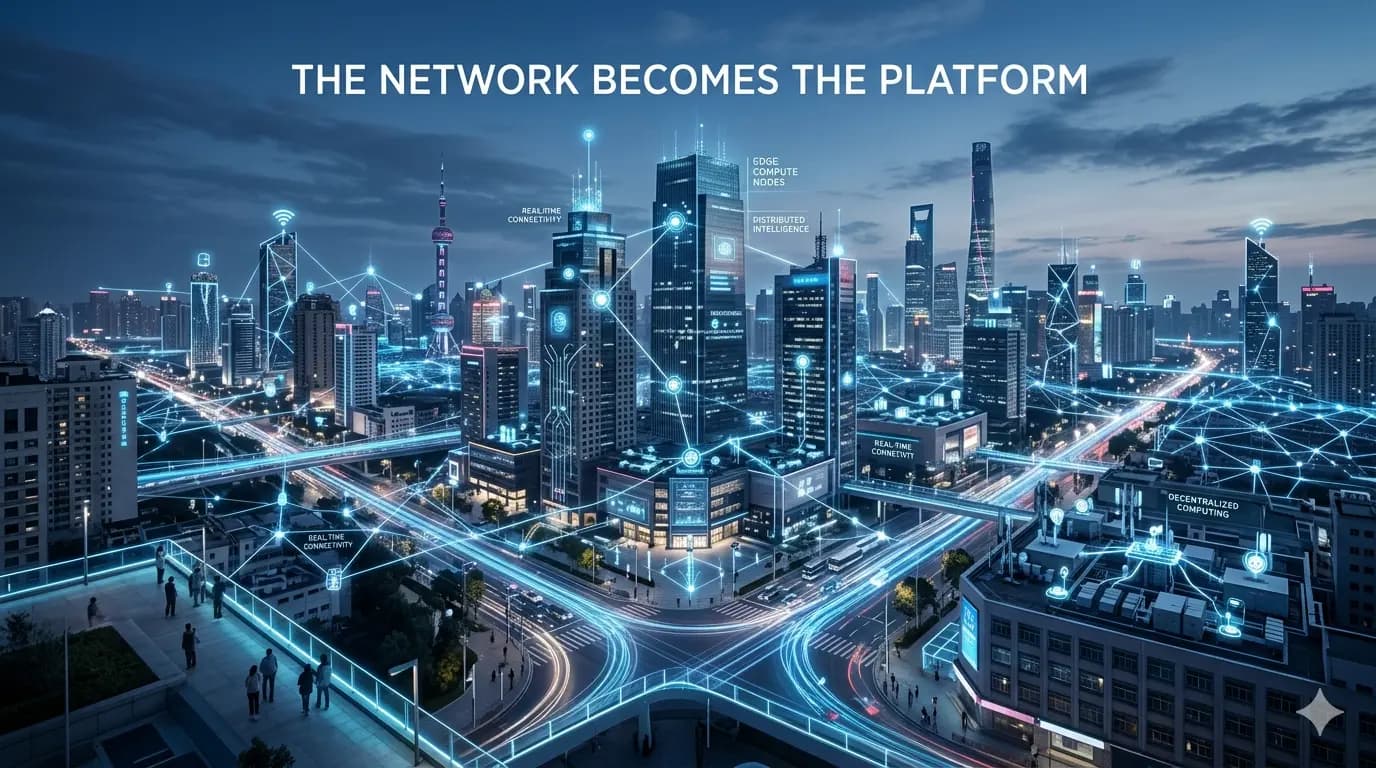
The Network Becomes the Platform
How Distributed Edge Infrastructure Is Reshaping the Internet
In previous discussions, we explored two ideas shaping modern connectivity. First, raw bandwidth and speed tests often fail to reflect real network performance. Second, the future of connectivity is shifting away from simply building larger pipes and toward designing smarter networks. But this raises an obvious question. If bandwidth alone is not the answer, and smarter networks are the future, what does that architecture actually look like? The answer is that modern networks are becoming distributed by design.
The Limits of Centralized Cloud For more than a decade, the dominant technology model was simple: move everything to the cloud. Applications, storage, and compute were centralized in large hyperscale data centers. Businesses connected to those data centers through increasingly large internet circuits. For many workloads, that model worked well. But as applications evolved, some limitations became visible. Real-time systems, AI inference workloads, and interactive applications are far more sensitive to latency than traditional workloads. Every additional network hop and every additional mile between the user and the application adds delay. At the same time, regulatory pressures and operational realities have increased the importance of data locality. Many organizations now need to control where data is processed and stored. The result is a growing realization across the industry: The future of cloud infrastructure will not be purely centralized. It will be distributed. Bringing Compute Closer to the Network Instead of relying exclusively on distant hyperscale data centers, distributed infrastructure places compute resources closer to where data is created and where applications are used.
This does not replace centralized cloud environments. Instead, it complements them. Some workloads still belong in large regional data centers. Others benefit from being executed much closer to the network edge. In practice, this means deploying localized compute clusters within metropolitan networks, allowing applications to run within the same geographic footprint as the users and devices generating the data. This approach allows certain workloads to operate with dramatically lower latency while also reducing the need to continuously backhaul large volumes of data across long distances.
What an Edge Zone Actually Looks Like One common misconception about edge computing is that it requires building miniature versions of traditional data centers everywhere. In reality, distributed infrastructure often looks very different. Rather than a single building filled with servers, edge infrastructure can consist of multiple interconnected locations distributed throughout a metropolitan network. At WiLine, these distributed clusters are referred to as Edge Zones. An Edge Zone is not a single site.
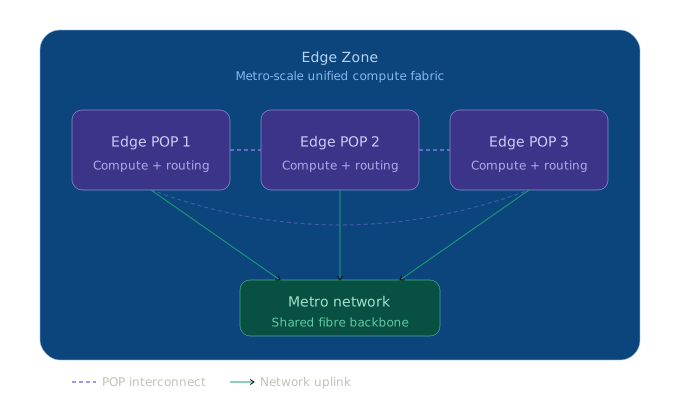
These locations are intentionally flexible. Depending on the market and available infrastructure, they may exist in: network aggregation facilities carrier-neutral buildings rooftop network hubs localized telecom equipment environments The goal is not to replicate a traditional data center footprint. The goal is to embed compute directly into the network fabric itself.
A Metro Compute Fabric The strength of a distributed edge model comes from how these sites operate together. Rather than functioning as isolated systems, Edge POPs are interconnected across the metro network and operate as a coordinated cluster. This creates a compute fabric capable of supporting: low-latency application execution localized AI inference workloads distributed storage metro-scale disaster recovery proximity-optimized virtual desktop environments Because the cluster spans multiple locations, the system gains both performance and resilience. Workloads can move between nodes, data can be replicated across sites, and compute resources can scale as demand increases. This type of architecture allows applications to operate within the metro footprint itself, rather than relying solely on distant cloud regions. The Role of Network Intelligence Distributed compute works best when paired with intelligent networking. Modern ISP architectures increasingly rely on technologies such as SD-WAN and policy-driven routing to steer traffic toward the most appropriate destination. Not all traffic is the same. AI workloads, SaaS applications, real-time communications, and traditional internet traffic each have different performance requirements. By identifying and steering traffic intelligently, networks can direct workloads toward the most appropriate resources: AI inference tasks may execute in the nearest Edge Zone SaaS applications may route toward optimized cloud paths general internet traffic may follow standard transit routes Rather than sending all traffic across a single path, the network becomes aware of where services exist and how to reach them efficiently. From Concept to Deployment While distributed edge infrastructure is still emerging across the industry, some providers are already beginning to deploy these architectures in real networks.
WiLine’s Edge Cloud initiative is designed around this model, creating metro-distributed compute fabrics composed of interconnected Edge POPs that operate as unified clusters. These Edge Zones integrate directly with the network itself, combining connectivity, compute, and storage within the same low-latency topology.WEC-ARM White Paper - The goal is not to replace the cloud, but to complement it allowing workloads that benefit from proximity to run within the metro network while still maintaining connectivity to centralized cloud environments when needed. In practice, this allows enterprises to treat the network itself as an extension of their infrastructure. The Network Becomes the Platform The internet is entering a new architectural phase. For decades, network design focused primarily on transporting data between users and distant data centers as efficiently as possible.
Now, the architecture itself is evolving. Instead of simply transporting data to centralized locations, networks are beginning to host compute resources directly within their infrastructure. This shift enables applications to run closer to the data, closer to the devices, and closer to the users who depend on them. And as real-time applications, AI systems, and distributed workloads continue to grow, that proximity will become increasingly important. The future of cloud computing may not be defined by a single location. It will be defined by how intelligently compute is distributed across the network.
Written by

Director of SASE
Matt Snell is the Director of SASE and Network Innovation at WiLine, bringing over two decades of hands-on experience in telecom and network engineering. He began his journey at ITT Tech in Spokane, graduating in 2002, and has been building and optimizing networks ever since.